
Introduction: When Words Don’t Come Easily
Communication is the bridge that connects your child to the world around them. For many children diagnosed with Autism Spectrum Disorder (ASD) in Delhi, building that bridge takes time, patience, and the right professional support.
Whether your child is non-verbal, uses only a few words, or struggles to carry on a conversation, Speech & Language Therapy (SLT) can make a profound difference. At Chetna Foundation — Delhi’s leading Autism Institute of Training and Research — our experienced Speech Therapists in Vasant Kunj and Dwarka work with children at every point on the communication spectrum.
“Every child has something to say. Our role as therapists is to help them find the best way to say it.”
What Is Speech & Language Therapy?
Speech & Language Therapy is a clinical intervention designed to assess, diagnose, and treat communication disorders in children and adults. For children with autism, it goes far beyond teaching words — it helps them understand language, use it meaningfully, and connect with others.
A qualified Speech-Language Pathologist (SLP) addresses a wide range of challenges including:
- Delayed speech and language development
- Difficulty forming words and sentences
- Challenges in understanding spoken instructions
- Problems with social communication — knowing when and how to speak
- Articulation disorders — unclear pronunciation
- Fluency disorders such as stammering or cluttering
- Voice disorders and swallowing difficulties
- Non-verbal communication including gestures and facial expressions
Why Do Children with Autism Need Speech Therapy?
Autism affects social communication at its core. Children with ASD often experience a mix of challenges — some may not speak at all, while others may have a large vocabulary but struggle to use language in social contexts (a condition known as pragmatic language disorder).
Common speech and language challenges seen in autistic children include:
- Echolalia — repeating words or phrases heard from others without communicating meaning
- Difficulty initiating or maintaining a conversation
- Taking language too literally and missing sarcasm, jokes, or idioms
- Trouble reading facial expressions, tone of voice, and body language
- Challenges with turn-taking in conversation
Speech therapy targets each of these areas through structured, play-based, and naturalistic methods tailored to the individual child.
What Happens During a Speech Therapy Session at Chetna Foundation?
At our Vasant Kunj and Dwarka centres in Delhi, every child begins with a comprehensive speech and language assessment. This helps our therapists understand the child’s current communication profile and design a therapy plan that is both realistic and ambitious.
A typical session may include:
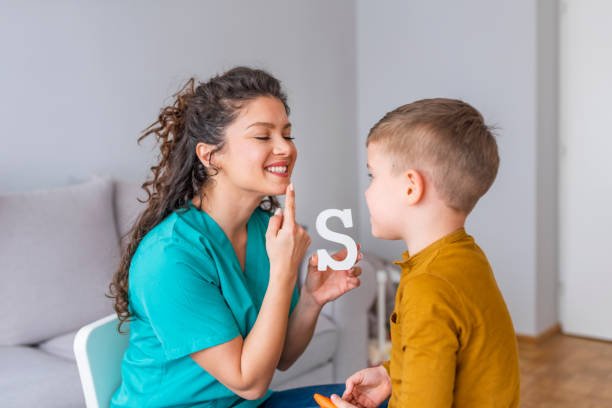
- Play-based activities to build vocabulary and encourage spontaneous speech
- Social stories and role-play to develop conversational skills
- Visual aids, picture exchange systems, and digital tools for non-verbal children
- Articulation exercises to improve speech clarity
- Parent coaching — teaching caregivers how to support communication at home
No two sessions look the same, because no two children are the same. Our therapists continuously track progress and adjust goals monthly in consultation with parents.
Augmentative and Alternative Communication (AAC) for Non-Verbal Children
For children who are non-verbal or minimally verbal, Augmentative and Alternative Communication (AAC) offers a powerful path to expression. AAC includes tools like picture boards, communication apps, speech-generating devices, and sign language.
At Chetna Foundation, our speech therapists are trained to introduce and support AAC as a bridge — not a barrier — to natural speech development. Many children who begin with AAC go on to develop functional verbal communication over time.
AAC does not stop a child from speaking. Research consistently shows it actually supports speech development by reducing frustration and building confidence.
How Long Does Speech Therapy Take to Show Results?
This is one of the most common questions parents in Delhi ask. The answer depends on several factors: the child’s age, the severity of the communication delay, the frequency of therapy sessions, and the level of parental involvement at home.
In general, children who begin therapy early — ideally before age 5 — and attend sessions consistently show the most significant progress. At Chetna Foundation, families from Vasant Kunj, Dwarka, Gurugram, and Noida regularly report visible improvements within the first three to six months of regular therapy.
Speech Therapy FAQs for Parents in Delhi
Q: At what age should a child start Speech Therapy?
There is no “too early.” If your child is not babbling by 12 months, not using single words by 16 months, or not using two-word phrases by 24 months, consult a speech therapist immediately. Chetna Foundation accepts children from 18 months onwards.
Q: Is Speech Therapy available in Vasant Kunj and Dwarka, Delhi?
Yes. Chetna Foundation’s fully equipped Speech Therapy centres are located in Vasant Kunj and Dwarka, New Delhi. We serve families from across the Delhi NCR including Gurugram, Noida, and Faridabad.
Q: Can Speech Therapy be combined with other therapies?
Absolutely — and it should be. At Chetna Foundation, Speech Therapy is often delivered alongside Occupational Therapy and ABA Therapy for maximum benefit. Our multidisciplinary team meets regularly to ensure every child’s therapy plan is coordinated and holistic.
Q: How can parents support Speech Therapy at home?
Speak to your child often, narrate daily activities, read together, and reinforce the vocabulary and phrases introduced in sessions. Our therapists provide parents with home practice guides after every session.
Why Choose Chetna Foundation for Speech Therapy in Delhi?
- Highly qualified Speech-Language Pathologists with specialized ASD training
- Individualized assessment and monthly goal-setting in collaboration with parents
- Use of evidence-based methods including AAC, PECS, and naturalistic language teaching
- Bilingual therapy support (Hindi and English) for families in Delhi
- Two accessible branches: Vasant Kunj (C-14, Nangal Dewat, Sector D) and Dwarka
- Nationally recognized institution, affiliated with INCOT Neurorehabilitation Conferences
Conclusion: Give Your Child the Gift of Communication
Speech is one of the most fundamental human abilities — and every child deserves the chance to communicate effectively. If you are a parent in Delhi concerned about your child’s speech or language development, do not wait. Early Speech & Language Therapy at Chetna Foundation can open doors you never thought possible.
Reach out to our team in Vasant Kunj or Dwarka today. We are ready to listen, evaluate, and create a plan tailored to your child’s unique strengths.